Summary
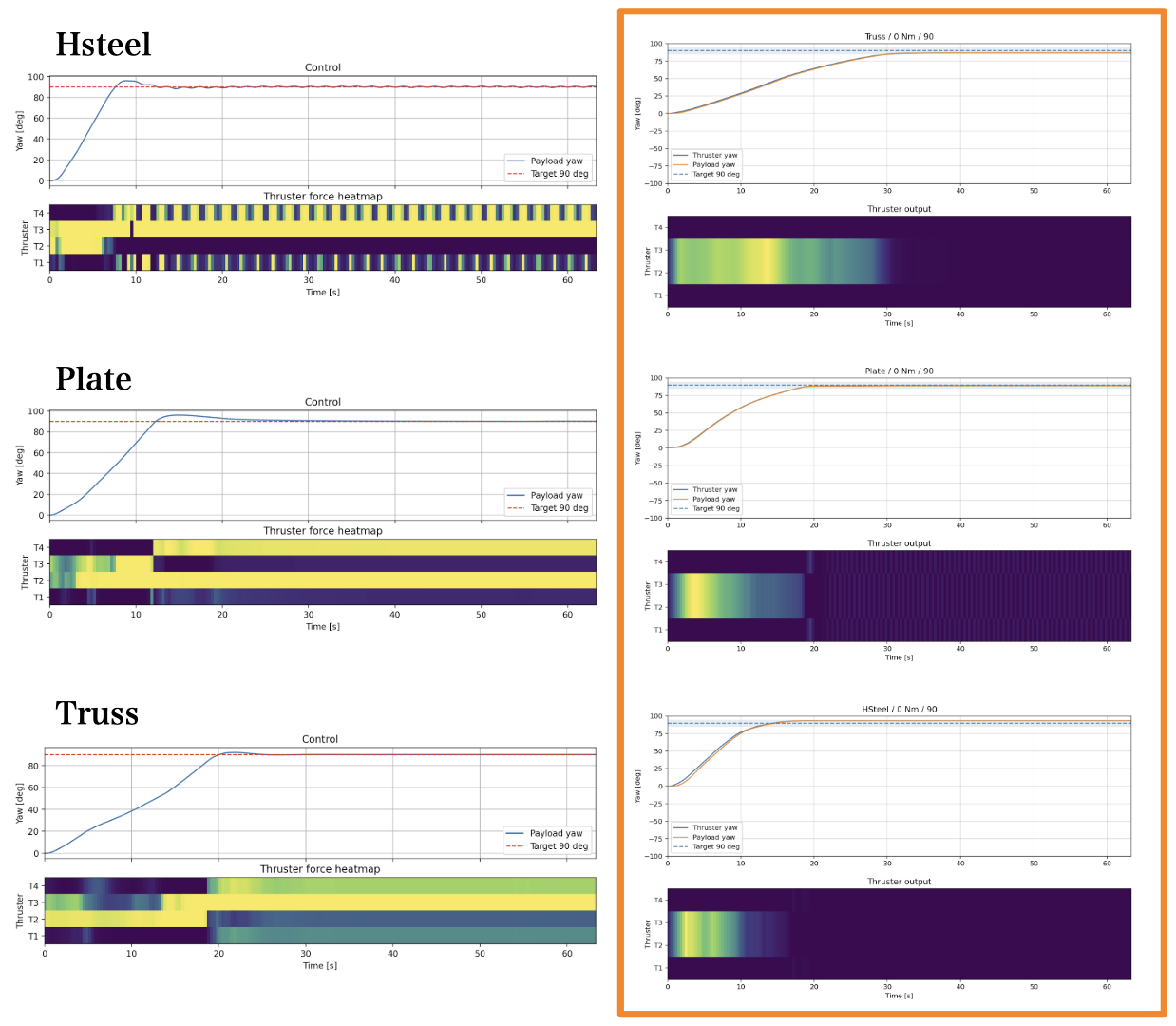
Low-output control and variable target yaw control were evaluated for three types of suspended payloads: H-steel, plate, and truss.
Variable Target Yaw Control
In Part 1 , the target yaw angle was fixed at 90°. In Part 2, the target was made variable over the range from −90° to +90°.
A single reinforcement learning model was used to control the payload toward different target yaw angles.
Low-output Control
The controller provides the thruster output required for rotation while reducing the output as the payload approaches the target yaw angle.
Compared with Part 1 , unnecessary thruster output after reaching the target angle was substantially reduced.
For all three payload types—H-steel, plate, and truss— variable target yaw control and low-output control were successfully combined.