Vision-Based Control
The Yaw estimation model and the payload Yaw control model were integrated to demonstrate a vision-based payload Yaw control system on a Raspberry Pi. Its control performance was then compared with that of the development environment.
Raspberry Pi Environment
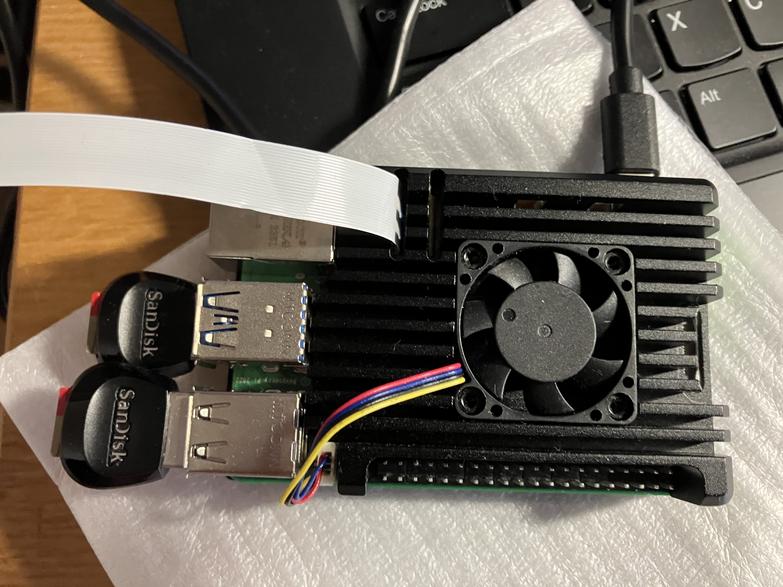
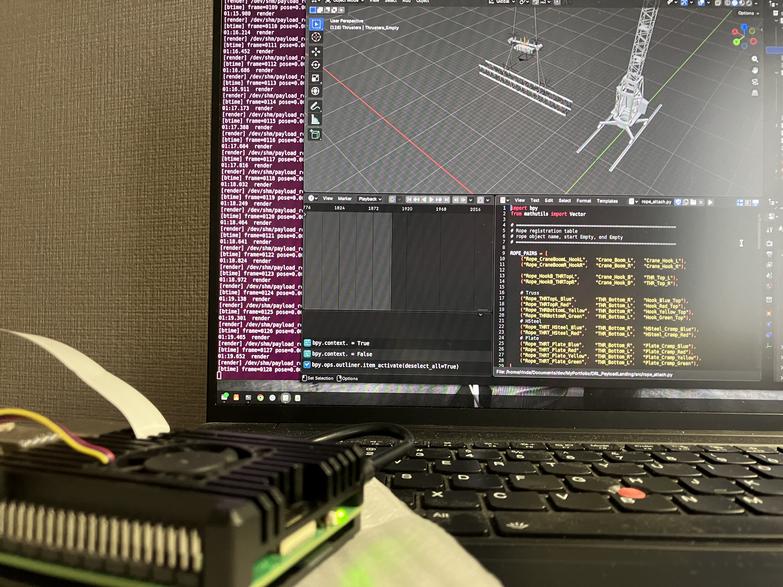
A Raspberry Pi was used as the controller. The camera images used as control inputs were generated by a 3D simulator running on a Linux workstation. The simulator updates each rendered frame based on the simulation state received from the Raspberry Pi.
System Configuration
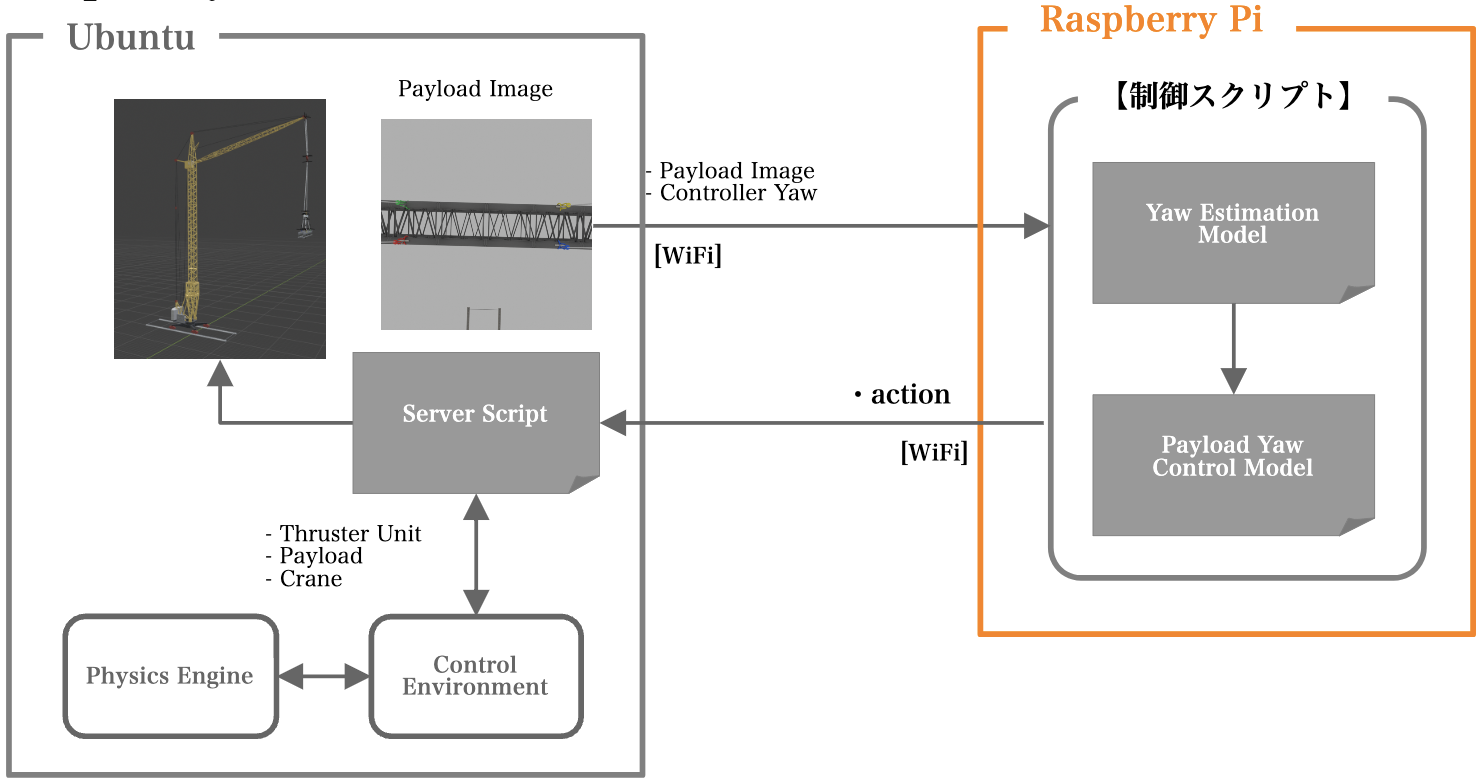
All estimation and control processes, except for 3D rendering, were executed on the Raspberry Pi.
3D Simulator
Generates the payload images used for Yaw estimation and sends them to the Raspberry Pi. The control model outputs commands for the four thrusters. The resulting simulation state is then sent to the 3D simulator for rendering.
Raspberry Pi
Estimates the payload Yaw angle from the input image and feeds the estimated value into the payload Yaw control model. The control model outputs the commands for the four thrusters, which are then sent to the 3D simulator.
Evaluation Method
Control experiments were conducted for HSteel, Plate, and Truss under the X1Y1 condition, which represents the strongest disturbance condition. The payload Yaw response and thruster output patterns were compared between the development environment and the Raspberry Pi environment.
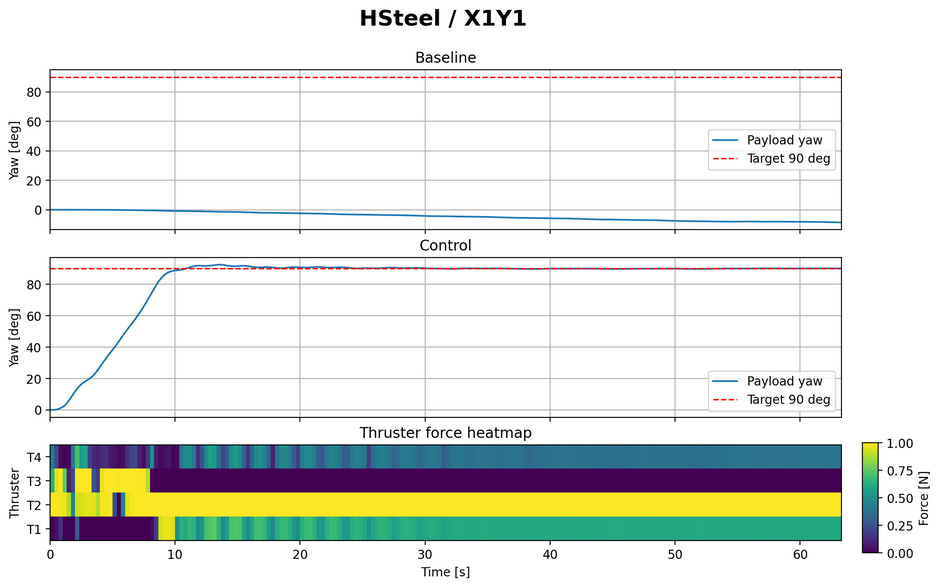
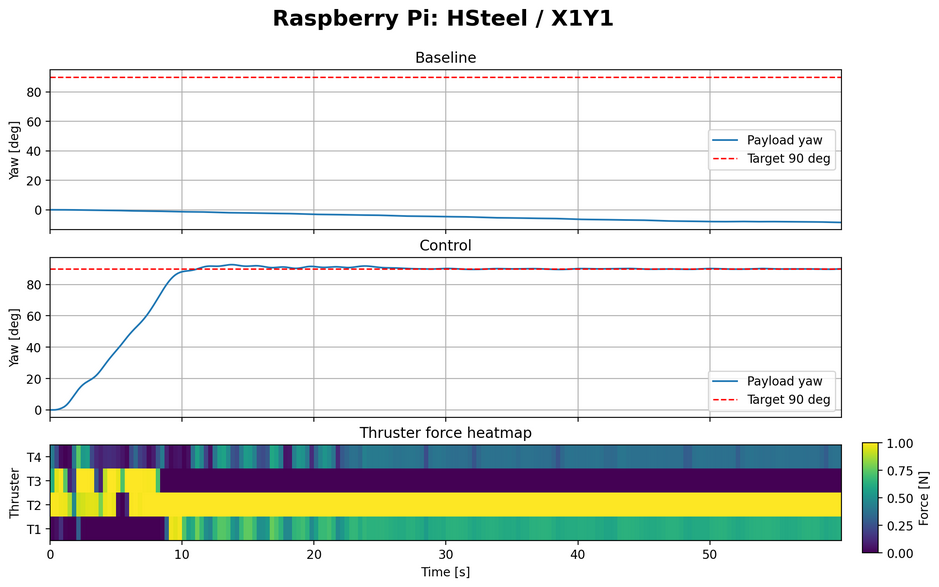
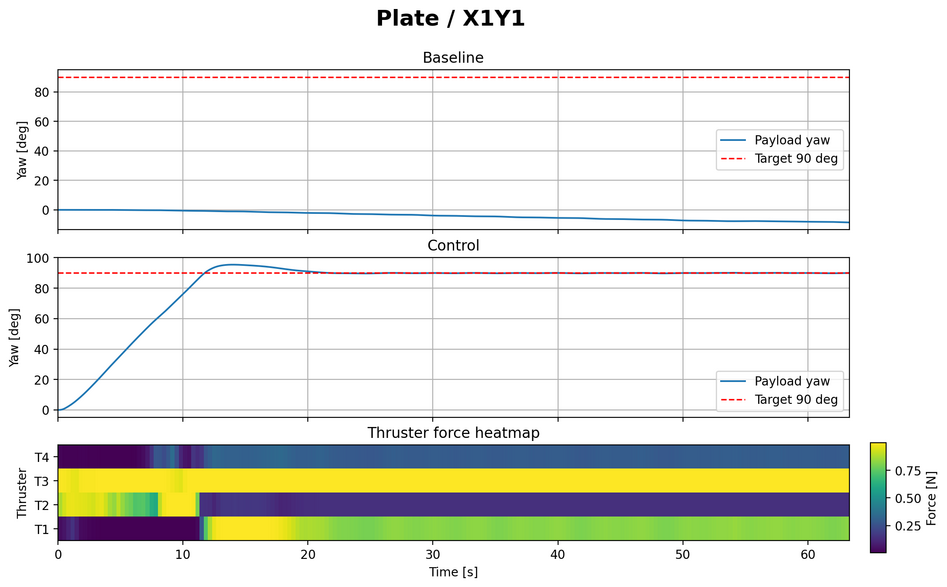
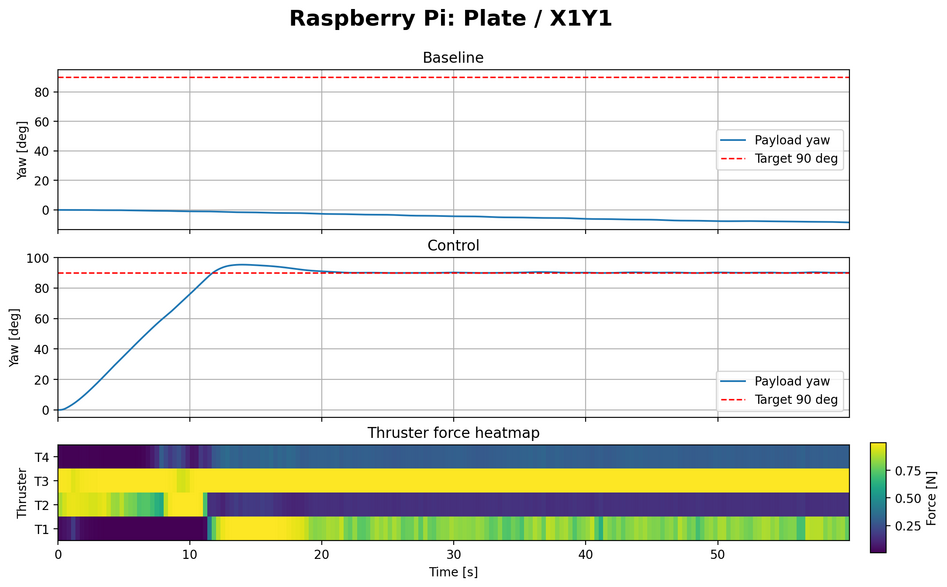
Payload Yaw angle without control.
Payload Yaw angle during control and the 90° target angle.
Outputs of the four thrusters. Brighter colors indicate higher thrust.
Visual confirmation of the payload motion during control.
HSteel
Payload Yaw control was evaluated using the HSteel payload. In the Raspberry Pi environment, the payload reached the target angle approximately 10 seconds after control started and then remained close to 90°.
Plate
Payload Yaw control was evaluated using the Plate payload. In the Raspberry Pi environment, the payload reached the target angle in approximately 13 seconds and then remained close to 90°.
Truss
Payload Yaw control was evaluated using the Truss payload. In the Raspberry Pi environment, the payload took longer to reach the target than in the development environment, reaching the target Yaw angle at around 60 seconds. Nevertheless, the payload ultimately reached the target angle and maintained its orientation.
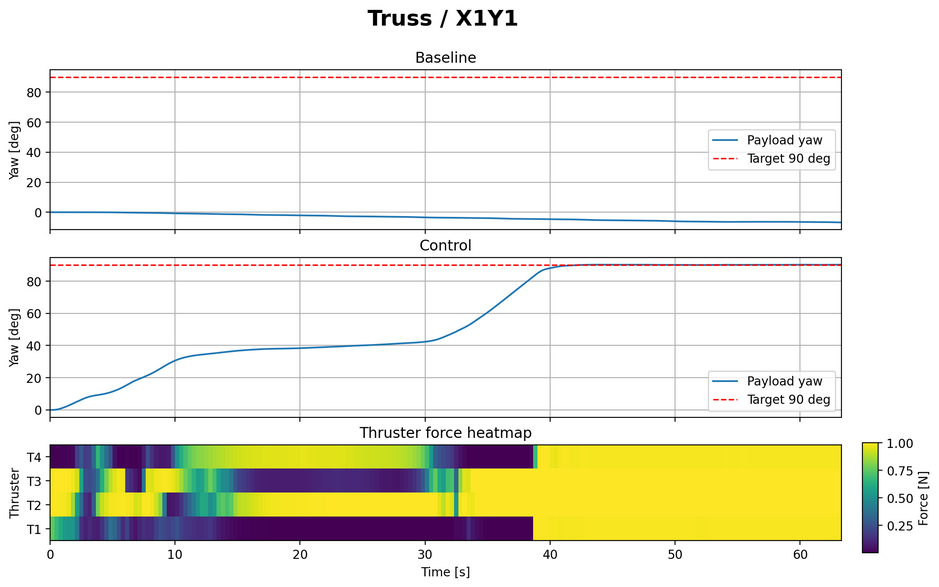
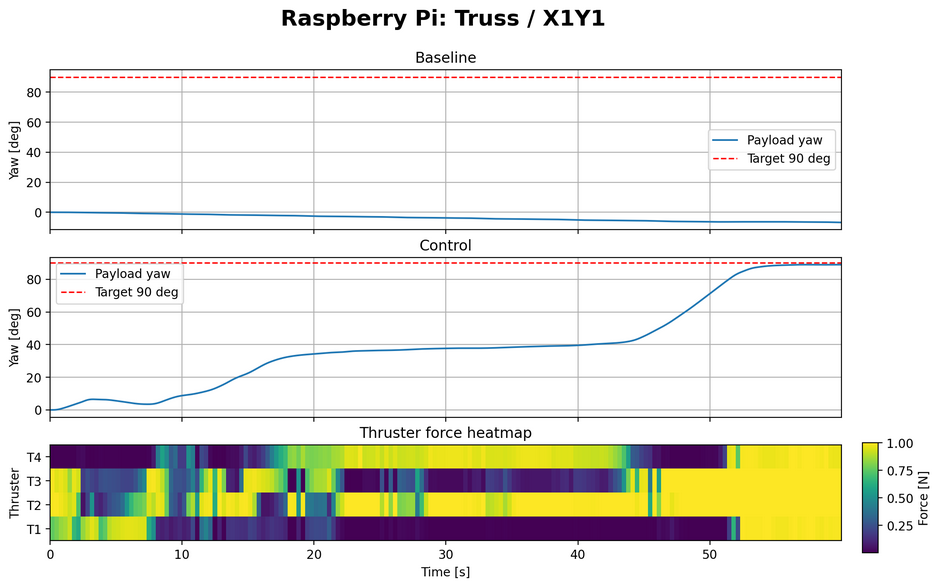
Although the thruster output pattern was similar to that of the development environment, the payload required more time to reach the target Yaw angle.
This difference is considered to be caused by errors in payload Yaw estimation. Truss / X1Y1 produced the largest Yaw estimation error, and even small estimation errors affected the output of the control model.